

What would make you try the unhelpful step?
The first move earned the bumblebee nothing. No sip of sugar water, no immediate payoff, and no obvious reason to repeat an action that seemed to lead nowhere.
That was the difficulty built into a laboratory puzzle described in a 2024 Nature study. To reach a reward, a bee had to move one part before another part could move, making the apparently unrewarding action essential.
For anyone who has watched an experienced person do something that once felt impossible, the setup raises a familiar question. How much does a difficult task change when another individual makes the missing connection visible?
The researchers were not investigating human learning, and the bees were not tiny pupils with human intentions. They were buff-tailed bumblebees, Bombus terrestris, encountering equipment that did not resemble a normal flower.
But the experiment challenged a surprisingly large assumption about such small animals. A behavior that the bees failed to discover independently might still be within reach through contact with a bee that already knew how to do it.
The compelling part is not simply that some bees eventually opened a box. It is the difference between how the original demonstrators learned and what happened to the inexperienced bees that joined them.
The reward was behind two different obstacles
In the original study by Alice Bridges and colleagues, the apparatus had a blue tab and a red tab. The blue tab first had to be pushed out of the red tab’s path.
Only then could the red tab move far enough to rotate a transparent lid and expose sugar solution on a yellow target. Pushing the blue piece alone did not deliver the food.
That separation mattered. The action required at the beginning was not the action immediately associated with drinking, creating a gap that ordinary trial and error did not readily bridge.
Researchers gave colonies without a trained demonstrator access to the puzzles over extended periods, including a condition lasting 24 days. No bee in those control experiments opened the complete two-step box.
This was not evidence that the bees lacked all interest in food. They continued to forage from opened boxes during the preparation sessions, while their attention to the closed puzzles declined over time.
Training the demonstrators was difficult too. Bees could learn to push the rewarded red tab, but the researchers initially struggled to get them to perform the unrewarded blue-tab action.
To teach that first movement, the team added a temporary reward beneath the blue tab. They later removed it gradually, building toward a bee that could complete the whole sequence with a reward only at the end.
The training history is crucial to the story. The demonstrators did not independently invent the solution; humans helped them acquire it before asking whether other bees could learn from their presence.
Another bee changed the learning conditions
The next stage brought inexperienced observers together with skilled demonstrators. Those observers had not already learned the puzzle’s individual steps, and they never received the temporary food reward for moving the blue tab.
Five of the 15 observers nevertheless acquired the complete box-opening behavior. That is a limited result, not a claim that every bee could do it, but it is a striking contrast with the unsuccessful independent attempts.
As BBC News reported in March 2024, the work suggested a more sophisticated form of social learning than researchers had previously demonstrated in insects. The observer bees could gain something from another bee’s activity that the control bees did not achieve alone.
Yet the phrase “watching and learning” can make the experiment sound more human than the observations justify. The paper describes bees following closely behind demonstrators, sometimes near enough to make contact with their antennae.
There were also different ways to open the puzzle. Some demonstrators used separate pushes, while others squeezed around the components in a more continuous movement.
All five successful observers had been paired with demonstrators using the squeezing technique. Successful learners also tended to use that technique themselves, making the physical route through the task worth paying attention to.
The authors discuss how following another bee could help reproduce the movement without requiring human-like imitation. The observed success does not establish that a demonstrator understood an observer’s confusion or deliberately set out to teach.
Those distinctions do not drain the finding of its interest. They show why a careful description can be more rewarding than the easy headline that bees have invented school.
The larger claim has an important boundary
The research connects to a question about cumulative culture: knowledge and behavior becoming more elaborate through innovations passed between individuals. Human lives depend on skills and discoveries that no single person could recreate from scratch.
This experiment addressed one component of that bigger idea. Could an animal acquire a behavior socially when independent discovery had proved too difficult under the tested conditions?
The results supported that possibility in bumblebees. They did not demonstrate wild colonies maintaining this particular skill across generations, nor did the researchers claim to have observed a growing bee technology outside the laboratory.
The paper explicitly notes that the study did not test whether a group would preserve two-step box-opening as a lasting tradition. It also acknowledges that an exceptionally rare bee might theoretically discover the solution independently.
That leaves a more precise conclusion than either “bees are just like us” or “nothing remarkable happened.” Social experience allowed some bees to acquire a difficult sequence that the controls failed to discover, even with extended opportunities.
The finding expands the questions worth asking about a small nervous system. It does not require us to pretend that the questions have all been answered.
A better question when someone gets stuck
There is no reason to capture garden bees or build home puzzles to make them perform. This was controlled research, not a suggestion that wild insects should entertain us.
The human takeaway is an analogy, not a teaching method proven by a bee experiment. When someone cannot complete a task alone, that failure may tell us something about the available route to learning, rather than everything about their ability.
In everyday life, a practical response could be to offer a demonstration instead of repeating an instruction more loudly. Ask whether the person would like to see the whole process, including the preparation an experienced hand might normally skip explaining.
Then leave room for them to try, ask questions, or decline the help. Demonstration is an invitation, not permission to take over, and nobody owes instant mastery in exchange for another person’s patience.
The bee study cannot promise that this approach will solve every human difficulty. Its quieter gift is a reason to hesitate before treating an unsuccessful solo attempt as a final verdict.
What is something you only understood after seeing someone work through it? Sometimes the part worth sharing is not the impressive finish, but the seemingly unhelpful first move that makes the rest possible.
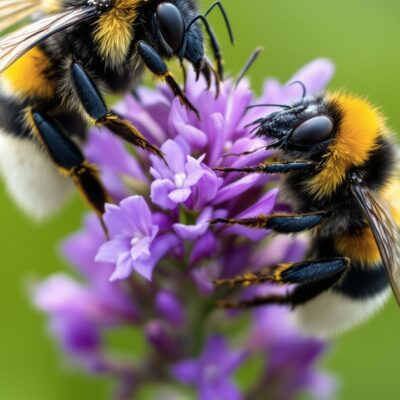
Image: AI-generated illustration of bumblebees, not a photograph of the study or its experimental equipment.