



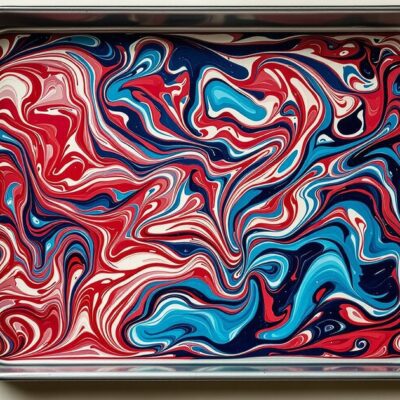
Image: AI-generated illustration of a marbling workspace, not a documentary photograph of an artist or a particular artwork.
The picture begins before the paper arrives
A sheet of paper can carry a painting that was first made somewhere else: on the surface of a prepared liquid. In the Turkish art of ebru, the paper receives a design that has already begun taking shape in a tray.
That small reversal is worth slowing down for. We usually imagine a picture beginning with a blank page and a person deciding what to put on it, but here the page enters a conversation already underway.
Color is sprinkled or brushed onto the surface, patterns are developed, and the image is transferred to paper. The result may suggest stone, foliage, or a flower, though reducing the tradition to pretty swirls misses much of its story.
There is an appealing tension in the process: something that looks fluid and temporary becomes something a person can hold. The finished sheet records work that happened in a different medium, under conditions its viewer may never consider.
For anyone who has abandoned a creative hobby because the first attempt looked nothing like the example, ebru offers a useful question. How much of the beauty we admire depends on preparation we never get to see?
The answer is not that skill is unnecessary, or that mistakes automatically become masterpieces. It is more interesting, and more generous to the people doing the work, than either of those promises.
A beautiful surface has an invisible foundation
The Turkish National Commission for UNESCO describes ebru as a traditional art in which pigments are applied to a prepared liquid and the designs are transferred to paper. Its account also connects the decorated sheets with the traditional craft of bookbinding.
That connection changes how the finished work can be understood. A decorated paper is not only something to frame; it can belong to the physical experience of a book, bringing visual pleasure to an object made to be opened and handled.
The commission describes natural pigments mixed with a few drops of ox gall before being applied to the thickened liquid. This is not simply ordinary paint dropped into a washing-up bowl, and a striking result should not be mistaken for an absence of technical knowledge.
The materials matter before a recognizable design appears. So does knowing how those materials behave together, which is less immediately visible than a finished flower but no less a part of making it.
Contemporary practitioner Sevim Surucu’s marbling website makes that practical side especially clear. Her guidebook description includes preparing the solution and paints, setting up the tray, mixing pigments, and troubleshooting difficulties.
Those are ordinary workshop concerns, not evidence of a secret talent that some people possess and everyone else lacks. The beautiful part and the problem-solving part belong to the same activity.
The quick reveal hides a much longer education
It is easy to focus on the moment a design reaches the paper. That moment offers an obvious payoff, while preparing materials and learning to handle them are harder to compress into a satisfying glimpse.
Yet the UNESCO commission’s account says that acquiring basic ebru skills takes at least two years. That description of traditional learning is a useful counterweight to the impression that a short demonstration reveals everything necessary to practice an art.
It should not be turned into a rule forbidding beginners from enjoying an introductory class. Trying something once and developing the dependable skills of a practitioner are different goals, and neither needs to pretend to be the other.
The same account describes knowledge passing orally and through informal, practical training in master-apprentice relationships. Instructions matter, but so does working alongside someone who can notice a difficulty and explain what to try next.
That human relationship is part of the heritage, not a disposable delivery system for a technique. A video can show a result; a teacher can respond to the particular result in front of a learner.
Ebru was inscribed on UNESCO’s Representative List of the Intangible Cultural Heritage of Humanity in 2014. The word intangible matters here because a collection of beautiful sheets cannot, by itself, preserve every skill and relationship involved in making them.
A tradition also needs people who practice, explain, and pass things on. Preserving the objects and sustaining the knowledge are related tasks, but they are not interchangeable.
The part that does not fit inside a frame
The commission’s description moves beyond the finished patterns to conversation and community relationships. It presents ebru as a collective art that can encourage dialogue and strengthen ties, practiced without barriers of age, gender, or ethnicity.
That is a description of the tradition’s social importance, not a clinical promise that marbling will cure loneliness or anxiety. No creative activity can guarantee belonging, and a welcoming environment still depends on how people treat one another.
Even with that limit, the human possibility is easy to recognize. Sharing materials, asking a question, and watching someone demonstrate a movement provide concrete reasons for people to spend time together.
Surucu’s site also shows that this is not a tradition confined to a museum description. It offers original works in floral, abstract, collage, and stationery categories, alongside teaching resources and hand-marbled papers.
Those examples allow room for more than one relationship with the craft. Someone might practice seriously, buy an original sheet, appreciate its place in book arts, or simply learn to recognize the labor behind it.
Respect begins with naming that labor accurately. Turkish ebru is a specific living tradition, not just a nameless visual effect available for a passing moment of inspiration.
A different way to look at your first attempt
If ebru makes you want to try marbling, start with an experienced instructor or a materials guide written for the method you intend to use. Ask about the preparation, safe handling, and disposal of the actual supplies rather than assuming every online demonstration uses interchangeable products.
You do not need to promise yourself a finished masterpiece. A more useful first goal might be learning what the materials do, identifying one difficulty, and understanding one adjustment that a teacher recommends.
For readers who never pick up a brush, there is still something to take home. When a skill looks effortless, consider what has been left outside the frame: practice, preparation, and the person who helped the maker learn.
That perspective can make us kinder beginners and more attentive viewers. It allows admiration to become specific instead of treating another person’s work as an inexplicable gift.
The lesson is not to abandon control and hope for beauty. It is to recognize that making something worthwhile can involve both careful preparation and a willingness to respond to what actually happens.
The paper arrives late in ebru, but it does not arrive by accident. Behind the moment worth watching are people who learned how to make that moment possible.