
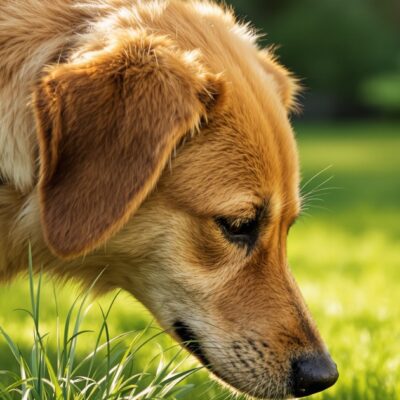

Featured image: AI-generated illustration of a dog exploring outdoors, not a photograph of a study participant.
The walk can look different from the other end of the lead
A dog stops beside a patch of grass, nose down, while the person holding the lead is ready to continue. It is an ordinary situation to imagine, and it contains a small disagreement: has the walk stalled, or is something worthwhile already happening?
I find that question more interesting than another instruction to make every outing longer. Distance is easy for us to count, but it cannot tell us everything about what an animal has been allowed to do along the way.
A study published in 2019 offers a useful reason to reconsider that distinction. Researchers Charlotte Duranton and Alexandra Horowitz compared two activities for pet dogs, then looked for a change in how the dogs approached an uncertain situation.
The appealing version of this story is that sniffing makes dogs happier. The actual experiment is narrower, and its details make the takeaway more useful than that slogan.
There was no questionnaire asking dogs how they felt. Instead, there were owners, two weeks of practice, and a bowl that did not give an obvious answer.
What caught my attention was not simply the result. It was the difference between giving an animal something to do and giving it some room to work things out.
Both groups received attention and food
As psychologist Zazie Todd explains in her detailed account of the research, twenty adult dogs took part. Half practiced nosework with their owners, while the other half practiced heelwork.
That comparison matters. The researchers were not contrasting an enjoyable activity with dogs being ignored; both groups moved around, worked with people, and received food rewards.
Each group attended a class, practiced at home daily for a week, then attended another class before a second week of practice. The tasks became more challenging as the dogs gained experience.
In heelwork, the activity involved walking alongside the owner, beginning with a small number of steps and building up. Changes in direction were introduced later.
For the nosework dogs, the activity began with finding food in a box and progressed to searching among boxes. The arrangement became more demanding during the second week.
These are different experiences even when both involve treats. In one, the person specifies the movement to follow; in the other, the dog has a problem to investigate.
That does not make heelwork bad, unnecessary, or unkind. Walking comfortably alongside a person can be a valuable skill, especially where traffic, other animals, or narrow spaces make safety the priority.
It does mean that successful obedience is not the only worthwhile thing an owner can offer. A dog can be well cared for in many ways, and still benefit from opportunities that are not mainly about following our directions.
The revealing moment happened somewhere in between
Before and after the two weeks, the dogs completed a cognitive bias test. First, they learned that a bowl in one position contained food, while a bowl in another position did not.
Then came the uncertain part: an empty bowl placed between those familiar locations. The researchers measured how long the dogs took to approach it.
The idea is straightforward without being a direct window into a dog’s thoughts. A quicker approach to an ambiguous location is interpreted as a more positive expectation that something worthwhile might be there.
The study abstract reproduced by Purdue University’s Canine Welfare Science resource reports that approach time declined significantly after nosework. In the heelwork group, approach time did not change.
That pattern supports the researchers’ interpretation of a more positive judgment bias, often described as optimism. It does not mean anyone established that dogs think about their future in the same way a person does.
I would also be careful about turning a small, short study into a universal promise. Twenty dogs and two weeks cannot establish how every dog will respond, how long any benefit lasts, or which everyday activity will suit a particular household.
Nor did the experiment isolate a single magic ingredient. Nosework involved scent, independent searching, and a different pattern of rewards; Todd discusses those possible explanations rather than treating the mechanism as settled.
Those limits do not drain the result of meaning. They help us keep the genuinely interesting finding without attaching a guarantee the researchers did not test.
The part I would bring home is not a stopwatch
It would be easy to turn this into another target: a certain number of sniffing minutes, a prescribed route, a new obligation to complete perfectly. But that would miss the question the study raises about choice.
The experiment tested structured nosework, not ordinary walks. Letting a dog explore a safe patch of ground is a practical idea inspired by the research, not a proven equivalent of its training program.
For an uncomplicated introduction at home, you can make a few pieces of your dog’s usual food easy to find in a clear, safe area while you supervise. Begin where success is obvious, rather than hiding everything so well that the game becomes frustrating.
Use food appropriate for that dog’s diet, account for it in the daily allowance, and avoid objects the dog might swallow. Separate animals if food creates competition, and stop if your dog loses interest or becomes uncomfortable.
If you want to develop the activity further, a qualified, reward-based instructor can help you build difficulty gradually. A dog with medical or behavioral difficulties may need individual guidance rather than a general enrichment suggestion.
The useful shift is modest: make room for exploration without demanding a particular emotional performance in return. Your dog does not need to demonstrate gratitude, excitement, or a better test score to justify an enjoyable activity.
A small way to notice the animal beside you
What stays with me is how often care gets measured using the things humans can record most easily. We can count steps, check off training sessions, and notice whether an animal responds promptly when asked.
Those measures can be useful. They are simply not the whole relationship.
Dogs rely heavily on smell, and the research gives us a reason to take scent-based activity seriously instead of treating it as the delay between more important events. Sometimes the investigation is the activity.
That is not an argument for letting a dog approach every unknown object or ignoring safety to preserve freedom. It is an invitation to distinguish a necessary interruption from an automatic one.
At a safe moment, with no urgent reason to move along, there may be room to wait. At home, there may be room for an easy search instead of another repetition of a command the dog already knows.
I do not read this study as proof that a simple game fixes distress or replaces veterinary care. I read it as a reminder that attention includes noticing which experiences matter to the creature receiving it.
The next time a walk seems to have stopped, the better question might not be how to get it moving again. It might be whether, from the dog’s side of the lead, it has finally become interesting.