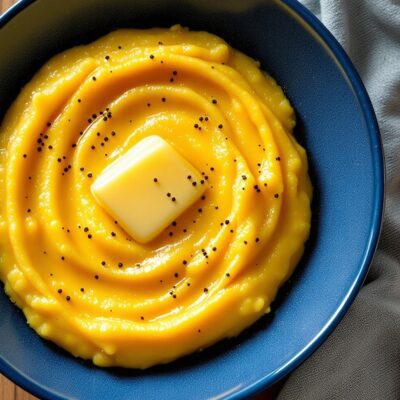




Featured image: AI-generated food illustration, not a photograph of a tested batch or a particular Italian kitchen.
The pot thickens before the work is finished
A pot of polenta can look ready before it is pleasant to eat. The cornmeal has absorbed enough liquid to become thick, the spoon leaves a trail, and dinner seems close, yet the grains may still feel sandy.
That is a frustrating little trick when you are hungry. You followed a short ingredient list, watched the water turn golden, and now the food appears to be asking for something the shopping list did not mention.
The missing ingredient is not necessarily more butter or another handful of cheese. Before reaching for either, there is a simpler question worth asking: have the grains actually softened?
Polenta, the cornmeal dish closely associated with northern Italian cooking, rewards that distinction. Thickness tells you something about the mixture, but it does not tell you everything about whether dinner is ready.
For a home cook, this is useful rather than intimidating. You do not need a beautiful copper pot, a family connection to Italy, or a complicated sauce to begin; you need a way to judge what is happening in the saucepan.
Once you have that, a humble bag of cornmeal becomes more than a backup ingredient. It becomes a warm foundation for the vegetables, beans, or sauce you already have.
A familiar dish with more than one family method
In her Savoring Italy polenta guide, recipe writer Lora connects the dish to her husband’s family in Como. She describes eating it both creamy with cheese and firm enough to grill, and says her husband serves it spread thickly on a cutting board.
That is her documented family connection, not a memory borrowed for this article. It offers something more useful than a claim that every Italian household cooks exactly the same way: one concrete example of how a simple dish can have several lives.
Her guide includes water-based instructions as well as a milk-and-water recipe. A separate Love Italy guide to creamy polenta starts coarse cornmeal in cold water and finishes with butter and Parmigiano Reggiano.
Those differences matter if you have ever felt defeated by conflicting recipes. One begins with hot liquid; another starts cold, and neither difference means you have discovered a secret test of whether you belong in the kitchen.
The shared practical advice is less dramatic: introduce the cornmeal gradually, keep the heat gentle, stir through the bottom, and allow the grains to become tender. Both guides also explain that extra liquid can loosen a mixture that becomes too thick.
Choose one method for your first pot rather than trying to combine every instruction you find. The water-based version below follows the proportions and cold-start approach in Love Italy’s guide, with a more cautious initial amount of salt.
A small shopping list, with room to pay attention
For about four servings as a base or substantial side, gather the ingredients below. This is an adaptation of the cited method, not a recipe we have independently kitchen-tested.
- 250 g traditional coarse yellow cornmeal suitable for polenta, not instant polenta
- 1.25 litres water, plus a little hot water for adjustments
- 1 teaspoon fine sea salt initially, with more to taste
- 40 g unsalted butter
- 50 g freshly grated Parmigiano Reggiano
- Freshly ground black pepper, to taste
Use a heavy, deep saucepan, a whisk, and a wooden spoon or heatproof spatula. Allow roughly fifty minutes, but treat the packet’s guidance and the tenderness of the grains as more useful than a promise that every brand finishes at the same moment.
First, put the water and initial salt in the saucepan. Sprinkle the cornmeal into the cold water gradually while whisking, so it disperses instead of arriving as one large mound.
Set the pan over medium heat and continue whisking as the mixture warms and begins to thicken. Once it is gently bubbling, reduce the heat to low and change to the spoon or spatula.
Cook at a gentle simmer for about forty to forty-five minutes, stirring every few minutes and scraping across the bottom and into the corners. Stay nearby and stir more often if it starts catching; vigorous bubbling can send hot polenta spitting toward your hands.
If the mixture becomes stiff while the grains still feel coarse, stir in a small splash of hot water and continue cooking. Do not pour in a large amount all at once and then rush to boil it away.
When the grains are tender, remove the pan from the heat and stir in the butter and cheese. Taste a cooled spoonful, adjust the salt, add pepper, and serve while the polenta is soft.
The useful test is on the spoon
The most helpful moment comes before the cheese goes in. Take a little polenta on a clean spoon, let it cool enough to taste safely, and notice the grains rather than merely the thickness.
If it is still gritty, more richness will not do the same job as adequate cooking. Give the pot more gentle heat and, when needed, enough additional water to keep it workable.
This is not a demand for endless stirring or perfect intuition. It is a small check that replaces a misleading visual cue with information you can actually use.
There is also no need to turn the topping into a second ambitious project. Spoon over warmed tomato sauce, cooked beans, or vegetables you have already roasted, and let the soft base bring the meal together.
Those are serving suggestions, not compulsory parts of a supposedly authentic plate. If someone at your table cannot eat dairy, Savoring Italy suggests cooking with water or broth and finishing with olive oil instead.
Keep the cornmeal packet in mind, too. Instant products are designed for a different cooking time, so substituting one into a long-simmered recipe without adjustment is not the same experiment.
Tomorrow’s texture is not today’s failure
Polenta firms as it cools. That can look disappointing if you expected the leftover portion to stay as loose as the spoonful you served straight from the pan.
But both recipe guides describe that change as another option. Transfer leftovers to a shallow dish, refrigerate promptly, and keep them covered in the refrigerator for up to three days.
You can reheat a portion gently with a little water, stirring until it loosens and is hot throughout. Or let it set in a lightly oiled dish, cut it into manageable slices, and pan-fry them in a little oil until heated through and golden on both sides.
The two meals will not have identical textures, and that is the point. Dinner does not have to repeat itself exactly to make good use of what remains.
There is a modest kind of confidence in learning a dish this way: not by memorizing a perfect photograph, but by understanding what to check and what to change. A thick pot is not always finished, and a firm leftover is not automatically spoiled work.
Sometimes a better supper starts with refusing to mistake the first visible change for the end of the story.