

The bird on the other side of the screen
The puff of air was not directed at the mother hen. It was directed at her chicks, on the other side of a clear screen, while researchers watched the adult bird and recorded what changed.
That arrangement is what draws me into a 2011 study from the University of Bristol. The question was not simply how a chicken reacts to something unpleasant, but whether what happens to another bird can produce a measurable response.
We use the expression mother hen so casually that it can feel as though there is nothing left to investigate. Yet a familiar phrase is not evidence, and a protective-looking movement cannot tell us everything about an animal’s experience.
The researchers needed more than an affectionate interpretation. They needed comparisons that could distinguish a response to the chicks’ situation from a response to the equipment, the noise, or the air itself.
For me, the interesting part is that they did not stop at watching. They measured changes that an ordinary observer might never notice, then asked how far those measurements could honestly take them.
The result is worth reading carefully, especially where the paper becomes more cautious than the comforting story we might want it to tell.
Four conditions, not one moving moment
In Avian maternal response to chick distress, Jo Edgar and colleagues describe testing fourteen hens that had successfully incubated eggs. The birds came from two traditional breeds, and each had a brood of chicks.
This was a small controlled study, not a survey of every kind of chicken or every situation in which birds live together. Keeping that scale in view helps the finding remain meaningful without making it universal.
The hens and chicks occupied separate compartments divided by a clear screen. Before testing, the birds were accustomed to the apparatus and the hens to the equipment used for non-invasive heart-rate monitoring.
Each hen experienced four conditions, repeated across two rounds. In one, both mother and chicks were left undisturbed; in another, the chicks received brief puffs of air.
A third condition directed the air at the hen herself. The fourth provided the sound of the air puff while directing it away from both compartments.
The noise-only comparison is easy to overlook, but it does important work. Without it, an increase in alertness might simply mean that the apparatus was making a sound the hen noticed.
Researchers compared a ten-minute period before treatment with a ten-minute treatment period. They recorded behavior and vocalizations alongside physiological measures, including heart rate and surface temperature around the eye.
These details turn a touching possibility into a question that can be tested. Instead of assuming the mother must be concerned, the design asks what changes, when it changes, and which alternative explanations remain.
The response was not an exact copy
When air was directed at either the hen or her chicks, the hens spent more time standing alert and less time preening. Their eye surface temperature also decreased in both situations.
Those findings alone would already complicate the idea that only direct contact matters. The hen’s behavior and physiology changed when the air was reaching her brood rather than her own body.
But the two responses were not identical. A significant increase in heart rate occurred when the chicks received the air puff, not when the hens received it themselves.
Maternal clucking also increased specifically in the chicks’ air-puff condition. The authors describe this kind of call as one that encourages chicks to follow the hen.
It is tempting to translate that immediately into a sentence a human parent might say. I would rather keep the observation intact: the call increased, and the pattern differed depending on which compartment received the air.
The University of Bristol’s research account published by ScienceDaily highlighted these behavioral and physiological changes. That account explains the same study; it is not a separate replication of the result.
There was another detail that made me pause. The chicks produced few distress calls, and the researchers did not find a significant increase in those calls during the treatment.
Nor did chick distress calls correlate with the hens’ vocalizations. That weakens a simple explanation in which the mother merely answers louder calling, although it does not identify exactly which cues she used.
The study did not record other aspects of chick behavior in the way needed to settle that question. The absence of an answer is useful information, not a gap to fill with an invented scene.
The most valuable sentence is a careful one
The authors linked the response to an attribute underlying empathy: being affected by what happens to another individual. That is a substantial possibility, but it is narrower than saying the experiment proved that chickens feel everything human parents feel.
The paper itself makes the distinction explicit. The measurements could not conclusively separate heightened attention or arousal from a response with a positive or negative emotional quality.
Put more simply, a changed heartbeat does not arrive with an explanation attached. It shows that something changed, while further evidence is needed to establish what that change felt like, if anything.
Heart-rate analysis also excluded two hens because complete data could not be obtained. This is another reason to describe the work as a specific experiment rather than a final verdict on an entire species.
I find the caution more encouraging than a sweeping claim would be. It leaves a real discovery standing: the hens responded differently depending on whether the mildly aversive event involved themselves or their chicks.
That is enough to challenge a dismissive assumption without replacing it with certainty about an inner life we cannot directly inspect. Respect does not require pretending the unanswered questions have disappeared.
The research also makes a practical welfare question harder to ignore. An animal’s surroundings include what happens to nearby animals, not just what physically touches its own body.
Attention without putting an animal to the test
This is not a home experiment to recreate. Deliberately startling chicks or separating a brood to obtain a reaction would turn a question about welfare into an unnecessary disturbance.
The more useful response is to let ordinary observation become less demanding. Watch from a respectful distance, avoid forcing an interaction for a photograph, and allow the birds to continue what they were doing.
Those are humane suggestions, not outcomes measured by this study. Anyone caring for chickens should seek suitable husbandry guidance and veterinary advice rather than use one research finding as a complete care manual.
For me, the human takeaway is about the limits of first impressions. Familiarity can make us feel that we already know a creature, especially one described so often in terms of food, productivity, or a stock phrase.
A careful experiment can interrupt that familiarity. It can reveal a response that was not obvious, while also reminding us how much remains uncertain.
The mother hen did not need to deliver a dramatic performance to make this question worth asking. The changes in her behavior and physiology were enough to deserve attention, and enough to invite a little more care in how we look.
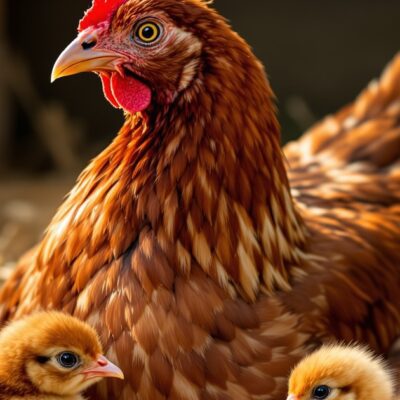
Image: AI-generated illustration of a hen and chicks, not a photograph of the experiment or its animals.