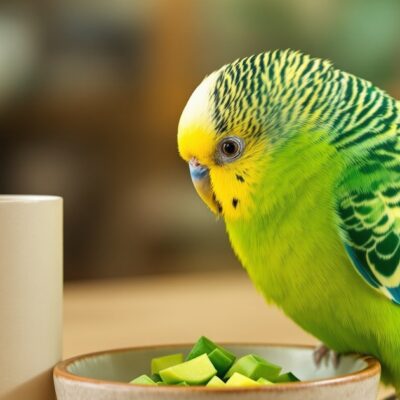


Featured image: AI-generated illustration of a pet parrot exploring food, not a photograph of a research animal or a tested enclosure.
The full bowl that leaves a question unanswered
A clean bowl full of suitable food looks like a job done well. If you care for a bird, making sure it has enough to eat is an obvious responsibility, and there is nothing wrong with feeling reassured when you have taken care of it.
But reading bird-welfare guidance made me stop at a different question: what has happened to the activity that used to come before the meal? A bowl can deliver the food without providing much opportunity to search, investigate, or work out how to reach it.
I find that distinction useful because it challenges an assumption without blaming the person who made it. Making an animal’s life easier and making its life richer are not always exactly the same task.
That does not mean a bird should have to earn its dinner. It means that good feeding can involve more than the contents of a dish.
For parrots, the difference has attracted both practical welfare advice and scientific attention. The interesting part is not a spectacular trick or an unusually clever individual, but an ordinary daily routine that people can easily overlook.
What disappears when the searching is finished for them
The RSPCA’s guidance on enrichment for pet birds describes foraging as a natural part of life in the wild. In human care, providing opportunities to perform such behavior is part of creating a more suitable environment.
Its suggestions include purpose-made puzzle feeders, scattering suitable food, and offering smaller meals in different places. The common thread is not making feeding difficult for its own sake; it is giving the animal something relevant to do.
That is different from buying an object simply because it looks entertaining to us. A bright toy can fill a corner of an enclosure without necessarily meeting the needs of the particular bird living there.
Foraging also asks us to separate two questions that often get bundled together. Is the diet appropriate, and does the way it is offered allow useful behavior?
A complicated feeder does not fix an unsuitable diet. Equally, selecting appropriate food does not automatically mean the bird has enough opportunities for activity throughout the day.
The RSPCA places foraging alongside other needs, including safe flight and suitable things to manipulate. It is one part of care, not a substitute for space, companionship appropriate to the species, or veterinary attention.
What stays with me is how ordinary the change in perspective can be. Instead of asking only whether the bowl is filled, we can ask what the bird is able to do around that daily event.
The researchers changed the route to the food
A study published in Animal Welfare in November 1997 explored that question through a deliberately constructed foraging device. Its published abstract describes a length of wood with holes containing food, covered with starch paper.
The researchers compared two arrangements. In one, each hole contained a food item; in the other, the same total amount of food was concentrated in fewer holes.
That design matters because the question was not simply whether more food changed behavior. The presentation changed while the total number of food items stayed the same.
The abstract reports that the parrots spent significantly more time allopreening during the enrichment period than before or afterward. Allopreening means one bird tending another bird’s feathers.
It also reports some evidence of contrafreeloading, the term used when an animal works for food even though food is available without that work. There was no preference for the variable distribution over the constant one.
That last result is worth keeping in the story. An appealing idea about variety did not automatically become a finding just because it sounded plausible.
This was historical research, not a newly announced discovery. Cambridge’s page carries a later online publication date, but the journal issue itself is from 1997.
The accessible abstract does not provide everything needed to assess the study in detail, including a full account of the birds and their individual responses. I would not turn it into a promise that any homemade puzzle will improve every pet parrot’s wellbeing.
The point is an opportunity, not an obstacle
The research and the welfare guidance point toward a more useful distinction than easy versus difficult. An activity can be accessible and still give a bird something meaningful to explore.
For a keeper considering a change, the sensible starting point is the individual bird: its species, health, mobility, usual diet, and experience with unfamiliar objects. An avian veterinarian can help make that assessment, especially if eating or weight is already a concern.
Keep familiar food accessible while introducing an optional, straightforward foraging opportunity. The goal is not to create hunger that forces a reluctant bird to solve a problem.
A purpose-made feeder suitable for that bird’s size may offer a manageable starting point. Watch the first interactions rather than assuming that a product sold for birds will suit every beak, foot, or level of confidence.
The RSPCA advises using safe, non-toxic materials and paints for enrichment. Materials also need checking for damage and potential hazards as the bird uses them; a toy’s condition can change through chewing.
Use appropriate portions of appropriate food, rather than letting enrichment become an unlimited supply of treats. Remove spoiled leftovers and keep feeding equipment clean.
If the bird seems frightened, cannot reach the food, or simply ignores the activity, that is information to respond to. Making the task harder is not automatically progress, and refusal is not a character flaw.
A different way to notice the bird in front of you
I like the question this leaves with the person doing the caring. Not how impressive the setup looks, but whether the animal actually has choices it can use.
There is no need to stage a dramatic before-and-after story. A useful observation might be as modest as whether the bird approaches voluntarily, can access the food safely, or returns to an activity after moving away.
Those observations are not a diagnosis of happiness. They are a way to pay closer attention while keeping the basics of feeding, housing, social needs, and health in view.
Changes in appetite, droppings, activity, or feather condition deserve veterinary advice rather than an assumption that boredom explains everything. Enrichment is care, not a replacement for medical assessment.
The full food bowl was never the enemy. It was simply answering one question while leaving another one open.
That is the hopeful part of this story for me: attentive care does not always begin with doing more. Sometimes it begins with noticing a part of another creature’s day that our helpfulness has quietly removed, then finding a safe way to offer it back.