

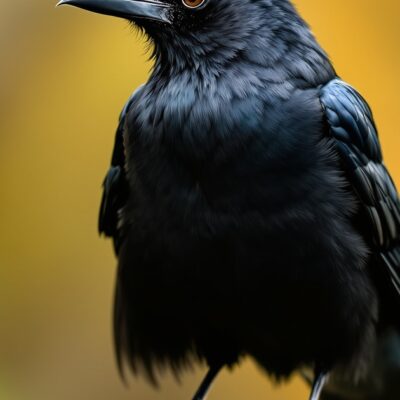
Illustration: AI-generated American crow, not a photograph of a research animal or an experimental encounter.
The bird that changes the question
I find it easy to think of a crow beside a footpath as part of the background. The research that unsettles that picture begins with a different possibility: while a person barely notices the bird, the bird may be learning something quite specific about the person.
That is not a claim that every crow knows every passerby. It is a reason to pause before treating an ordinary encounter as something that disappears the moment we walk away.
In experiments near Seattle, researchers wore distinctive masks while capturing, banding and releasing wild American crows. Later, people wearing the masks walked through the study areas, and the birds’ responses were recorded.
The striking question was not simply whether the captured birds reacted. It was what happened among birds that had never been caught by the masked researchers, and among young crows learning about their surroundings.
I expected a story about memory. What held my attention was the possibility that an experience could matter beyond the individual who had it, changing how other birds responded to a face.
That makes this more interesting than the familiar warning that crows hold grudges. A grudge is our interpretation; the researchers had to work out what the birds actually learned.
A mask made the difference testable
The study by Heather Cornell, John Marzluff and Shannon Pecoraro, published online in 2011, investigated how information about dangerous humans spread among American crows. The work involved five sites near Seattle, with a longer observation period at the University of Washington campus.
At each site, researchers paired capture with a particular face mask. The birds were released unharmed, but being captured was an aversive experience that could give the otherwise unfamiliar face a meaning.
Other masks were not associated with capture. Those comparisons mattered because a crow might react to an unusual-looking person without recognizing a specific source of danger.
The researchers then recorded scolding and mobbing. Scolding meant repeated harsh alarm calls directed at the observer, accompanied by agitated movements; mobbing involved more than one crow joining in.
These were defined behaviors, not guesses based on whether a bird appeared offended. The distinction helps keep an appealing story connected to evidence rather than to the feelings we might assign to a black bird calling overhead.
Previously captured crows could distinguish the mask associated with capture from neutral masks. Yet many birds involved in later scolding had not been captured in that masked trapping event.
That left an important puzzle. Were those birds learning the face, or simply joining a noisy group without retaining anything about the individual at its center?
The quieter moments told researchers more
A crowd of alarmed birds can make a strong impression, but it cannot answer that puzzle on its own. An animal can become agitated because others are agitated, without learning what started the disturbance.
So the researchers paid attention to lone crows that had not been captured. If those birds later scolded the mask on their own, the explanation could not be only the immediate excitement of joining a mob.
Across the shorter experiments, lone, unbanded birds became better at distinguishing the mask associated with capture from neutral masks. Their responses were consistent with learning through watching other birds.
The authors also described a limitation that deserves to stay in the story. Because unbanded birds could not always be individually identified, some conclusions depended on observations at locations rather than on a complete record for every crow.
That does not make the finding empty. It means the evidence is strongest when we describe it at the level the study supports, instead of pretending researchers tracked every lesson passing between two identifiable birds.
Young crows supplied another part of the picture. After observing their parents scold the mask, some later scolded it when their parents were absent.
The research supported both learning among peers and learning from parents. It did not show that crows tell detailed stories in the human sense, or that they deliberately explain a person’s history to their young.
For me, the careful version is already remarkable. A bird need not experience the original capture to develop a response to the face associated with it.
Remembering a face is not only about danger
At the long-term campus site, responses to the mask spread and became more frequent over years. Repeated encounters gave birds opportunities to observe others responding, so this was not a simple test of an untouched memory sitting unchanged for five years.
That detail changes how I read the usual headline about an unforgettable human enemy. The story includes continuing social experience, not just one extraordinary memory locked inside one bird.
There is a gentler companion to the finding. A separate University of Washington report from 2012 describes brain-imaging research with twelve adult male crows and two kinds of learned association.
One mask was worn during capture. A different mask was worn by people who fed the birds during four weeks in captivity, and both faces carried neutral expressions.
The researchers studied brain activity while birds encountered a face associated with capture or care. All the birds were returned to the wild after the work was completed.
This was a separate experiment, not another stage of the field study. It adds evidence that a familiar face can acquire different significance through treatment, rather than through its expression alone.
I would not turn that into a promise that a wild crow will become someone’s friend. The more useful point is that these animals can distinguish experiences we might casually lump together as contact with humans.
A better way to share an ordinary path
Neither study is an invitation to test a neighborhood crow by frightening it, approaching a nest or trying to provoke a memorable response. Curiosity is not a reason to create the very distress a researcher was trying to understand.
The practical takeaway can be much quieter: allow space, avoid harassment and watch without demanding an interaction. If a bird becomes alarmed, giving it distance is more considerate than staying to see what it does next.
That advice does not require a belief that crows judge our character. It follows from recognizing that our behavior can become meaningful to another animal, even when the encounter seems unimportant to us.
I like the shift this makes possible. Instead of wondering how to become special to a wild creature, we can ask how to be less disruptive in a place it already inhabits.
A familiar footpath can remain familiar while our understanding of it changes. The birds along it are not simply decorations that move when we get too close; they are living through their own encounters and learning from some of them.
The mask experiments cannot tell us what any particular crow thinks when we pass. They do give us a grounded reason to carry a little more care into that passing moment, even when we expect nothing back.